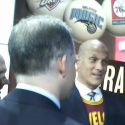
Dwight Howard and Jeremy Lin.
Andrew Bynum and Kyrie Irving.
If you were trying to build a team from nothing, which tandem would you rather have?
Houston Rockets GM Daryl Morey has spent the entire offseason trying to put together the first tandem. He reeled in Lin on Tuesday night but has been unable to get the Orlando Magic to budge on Howard.
Cleveland Cavaliers GM Chris Grant may be trying to put together the second tandem. He drafted Irving just over a year ago and reportedly may be trying to acquire Bynum in a three-team trade that would send Anderson Varejao and draft picks to the Magic and Howard to the Los Angeles Lakers.
All four players are still very young, ranging in age from Irving’s 20 to Howard’s 26. All four have had serious injuries in the last 18 months, ranging from a broken hand to a bad back to multiple knee woes. All four appear to have considerable clearance between where they are now and their ceiling.
Before you answer – and we expect you to answer in your typical Sheridan Hoops reader spirited fashion in the comments section below – we thought we’d break down all four players, then give you our choice.
DWIGHT HOWARD
Upside: The best center in the game and a top-five player. … Arguably the best rebounder in the league and inarguably the most impactful defensive player. … Excellent pick-and-roll player whose low-post game is clearly improving. … Good composure with opponents given the beatings he takes from them on a nightly basis. … When he is on your team, you can pencil in 50 wins and a playoff berth regardless of the personnel around him. … Figures to get better.
Downside: Behavior over the last year has made him the biggest diva in the NBA. … Doesn’t make his free throws and never will. … Previously indestructible reputation tarnished by back injury last season, which could be a problem going forward. … Poor composure with referees and a threat to face suspension every season. … Not as good as LeBron James.
JEREMY LIN
Upside: Pass-first point guard and an outstanding pick-and-roll player. … Underrated as both a finisher
around the rim and as a distance shooter. … Embraces the big moment when most players with his background and lack of experience would shy away from it. … Remarkable composure both on and off the court. The PR department can stand at ease when he speaks to the media. … Now that he’s out from under the media microscope of New York, figures to get better.
Downside: His current level of play has been sustained for less than half a full season. … Broke down at the end of last season with a knee injury, raising questions about his durability. … Not a good defender, which may be attributable to his limited experience. … Has a tendency to play outside of his limitations, which makes him highly prone to turnovers. … Not as good as LeBron James.
ANDREW BYNUM
Upside: The second-best center in the game and a top-15 player. … Could be a perennial top-five scorer and rebounder in a situation where he is the first option. … Has strong footwork and great hands which allow him to catch and deliver shots or passes from rim height, removing help defenders from the play. … Probably would benefit from a change of scenery where he is not in the shadow of a huge star. … Figures to get better.
Downside: Until this past season was remarkably injury-prone with troublesome knees that already have undergone three surgeries. … Has exhibited knucklehead behavior on several occasions, whether it be firing 3-pointers in transition or taking cheap shots at opponents or illegally parking in spots for the disabled or skipping meetings with the general manager. … May not have the maturity to deal with the responsibility of being “the guy.” … Not as good as LeBron James.
KYRIE IRVING
Upside: Phenomenal penetrator who can get to the rim and finish against any defender. … Not a volume
shooter and effective enough from 3-point range to keep defenses more than honest. … Showed an innate ability to take over games down the stretch, uncommon for any rookie. … More than held his own against Team USA’s trio of All-Star point guards this summer. … Figures to get better.
Downside: Still has a shoot-first mentality that limits his ability to make teammates appreciably better. … Has to stop settling for pull-up jumpers and develop his in-between game to better take advantage of his excellent free-throw shooting. … Has to improve his commitment to the defensive end. … Has had a serious toe injury, a sprained shoulder and a broken hand in the last 20 months, raising questions about his durability. … Not as good as LeBron James.
So which tandem do you take?
I see the argument for Bynum and Irving. Both have room for expansive growth as players – Bynum because he has played in the shadow of Kobe Bryant and Pau Gasol for several years, Irving because he plays a position that requires the development of the highest basketball IQ. Given their youth, they could forge a bond that could last a decade. But they seem like a give-and-go tandem.
Not that there’s anything wrong with that. Maybe I’m wrong, but it just seems that the relationship between point guard and center in today’s NBA should be more pick-and-roll than give-and-go.
I am not a huge fan of either Howard or Lin. I have been worn down by Howard’s incessant petulance and I have serious misgivings about Lin’s ability to approach and sustain the ridiculous level he briefly established last season. And I don’t believe either player has another quantum leap in him; going forward, any uptick will be incremental.
But Lin made Amar’e Stoudemire and Tyson Chandler more effective; even better, he made himself more effective by playing off them. His potential fit with Howard feels similar, with lobs and jumpers off the screen and twisting, driving layups and follow hammer dunks. Right now, Lin and Howard just seem like they fit together better.
That’s the pedantic answer. The short answer is Howard is by far the best player of the four. So I’ll take the tandem that includes him.
You can agree or disagree below.