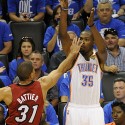
The big trade between the Oklahoma City Thunder and the Houston Rockets shook the basketball world on Saturday evening. Ever-so-close to the pinnacle last season, the Thunder were supposed to bring back third musketeer James Harden to compete for the Western Conference championship and NBA Finals this season and for many more to come.
And then… Poof! Voila! Vamoose!
Harden is 445 miles south in Houston with his ex-Thunder teammates Lazar Hayward, Daequan Cook and Cole
Aldrich.
Kevin Martin, his expiring $12 million contract and rookie Jeremy Lamb are headed north to OKC for the 2012-13 season, along with two 2013 first-round draft picks (Toronto’s top-3 protected pick, as well as Dallas’ selection). The Thunder also received the Bobcats’ 2013 second-rounder.
People have been quick to judge this deal — perhaps none more so than our own Chris Bernucca, who hates it from OKC’s standpoint. And we are using the word “hate” loosely. And while everyone is entitled to their opinion, mine is that the end results of this trade won’t be realized until years down the road.
Along with factoring in how Martin and Lamb develop as members of the Thunder, we need to analyze the utilization of the draft picks Oklahoma City acquired to make sense of this deal.
For the Rockets, the trade will be primarily judged by the ability of Harden to become a true maximum salary player. If Aldrich, Hayward and Cook (who is a one-year rental) can become adequate role players, they’ve done their job.
For the Thunder, and their fans, it is more emotional — and with good reason.
With a chance to compete for multiple championships, how could management let Harden get away when the sides were a mere $6 million apart?

Quite simply, Durant is a more pleasant, affable version of Tim Duncan. He is comfortable enough in his own skin to find contentment with being big-time in a small market. And you get the sense that others who perform under brighter lights might be a bit jealous.
when Allen Iverson took on Shaquille O’Neal, Kobe Bryant and the Lakers. And the Heat and Thunder will do it despite playing in TV markets ranked 16th and 45th nationally and 14th and 28th among NBA cities. … The Heat have used seven different lineups in the postseason. The Thunder have used one. … If the NBA gets its way, this summer’s Olympics will be the last that are open to all players. The league is pushing hard for basketball to follow soccer’s international model. “For the Olympics only, it would be 23 and under,” deputy commissioner Adam Silver said. “For the World Cup of Basketball, just like with the World Cup of soccer/football, that competition would be eligible to anyone.” Restricting participation will not diminish interest in the Olympics, which are a self-sustaining global spectacle that transcends basketball. But there could be some resistance from FIBA, which undoubtedly has already heard complaints from other countries about age limitations. For example, Spain’s Olympic roster this summer will include the Gasol brothers, Serge Ibaka, Jose Calderon, Juan Carlos Navarro and Rudy Fernandez, none of whom would be eligible for the 2016 Games. As for Team USA, it is almost impossible to envision its 2016 rosterif the 23-and-under proposal goes through, because it will be primarily comprised of players currently in college and even high school. … Teams don’t regularly play three straight home games in the playoffs – at least until the Finals – but the Thunder just did, and alarming trend emerged. In Game 6 vs. San Antonio and the first two games vs. Miami, Oklahoma City quickly fell behind by double digits. The Thunder were scrambled for wins in the first two games but could not get all the way back in Game 2 vs. the Heat. Now they face three straight games in a tough venue and have to find a solution to the problem quickly. “That was the game. We can’t start off down 18-2,” said Kevin Durant, who had his team’s only basket in that awful start. “We can’t go down that much, especially at home. We’ve got to correct it.” … Much has been made of the superstar showdown between MVP LeBron James and scoring champion Durant and how much they are guarding each other. Through the first two games, Durant has defended James more than vice versa simply because the Heat have more versatile defenders than the Thunder. Miami has gotten a little tricky with James, starting him on center Kendrick Perkins and switching the pick-and-roll onto Durant, because Oklahoma City simply refuses to throw the ball to Perkins in those sets. Despite the extra energy James expends by defending Durant, Heat guard Dwyane Wade likes the matchup. “I’m glad that he has that challenge because it’s going to make him focus more. It’s going to make him play a little different,” Wade said. “I’d rather for him to be guarding Kevin Durant than to have to guard DeShawn Stevenson like last year, where he wasn’t as involved. And also Shawn Marion, he wasn’t as involved. Kevin Durant, you’ve got to have your antennas up at all times.” … When Miami was edged, 24-23, in the third quarter of Game 2, it marked just the third time in 20 postseason games involving the Heat that the winner of the third period did not win the game. … Durant wasn’t the only Thunder player who spent offseason workouts alongside an MVP in James. Guard Russell Westbrook has been doing it every summer since he was drafted with Derrick Rose, the 2011 MVP. “It started off with my first pre-draft,” Westbrook said. “We worked out every summer since then. It’s definitely helped both of us get better. I learned some things from him, he taught me a few things, and it’s definitely made us better players, made us better players for our teams, as well.” Westbrook needs to start putting some of those lessons to good use. Despite averaging 27.0 points in the first two games, he has shot just 20-of-50 from the field. When you add his four turnovers, Westbrook has been personally responsible for a maximum of 34 empty possessions, easily the most of any player in the Finals. His points per shot is 1.08, well off his regular season number of 1.23. By contrast, Thunder teammate James Harden leads all postseason players attempting at least 10 shots per game with a PPS of 1.58 after finishing the regular season at 1.66, second to Tyson Chandler (1.97). Through the first two games, Wade has a PPS of 1.10, James is at 1.35, Durant is at 1.62 and Shane Battier is at a spiffy 2.0. … David Stern occasionally allows the media to read the tea leaves by offering a prediction or outlook on a certain situation. But he refrained from that approach regarding the Sacramento Kings, who appeared all set for a long stay in California’s capital until the Maloof family backed off on its financial part of the arena plan, leaving the Kings in long-term limbo, with Anaheim and Seattle wiping their collective drool. “On other situations I might hazard a guess for a prognostication,” Stern said. “On this one, I’m out of the business for now.”
Mark Titus and I have three things in common.
Florida told a teammate, “It’s only a game. Stop crying like a little bitch.”