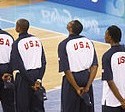
NEW YORK, Aug. 3, 2012 — Being that I was 38,000 feet in the air, enjoying the comforts of the business class cabin of a KLM 747 when the United States was rewriting the record book against Nigeria, I set out to watch the streaming replay before dawn this morning on NBCSports online.
Black screen. Nothing would play. Nothing.
Tried it four times, logging out, logging in, changing my Internet provider password, etc. Can I have the last 45 minutes of my life back? Is this what y’all were tweeting about in the #nbchate hashtag campaign I was reading about while in Europe? Is this just the tip of the iceberg? (It’s been 20 years since I was subjected to watching the Summer Olympics on NBC).
I’ve just returned from France, where there are almost no commercials cluttering the coverage — but almost nothing to watch that interested me. You like judo, team handball and equestrian? Then get thee to France. Stuff is on nearly 24/7.
One break Parisian viewers received was a live feed of the France-Argentina game a couple nights ago, followed by the US-Tunisia game on one of the cable channels. I watched it at a tavern called the Great Canadian in the center if Paris, where the following two photos show what I saw in front of me, and what I saw if I looked behind me.

France-Argentina on TV in Paris

Cathedral of Notre Dame in Paris
So you’d think “The Great Canadian” is a redundant name, right?
I did, until I saw what they were charging for a pint of beer — 7.50 Euro, which equals $9.18. There are nightclubs in Vegas, tourist traps in Manhattan and ballparks all across America that won’t cross the $9 beer threshold, but I found the place that is bucking the trend.
One of my tweeps, an attorney and a huge Knicks fan, had read diary Edition III, which dealt with the Boris Diaw burger, free Frosted Flakes and other assorted anecdotes, and he saw that I had announced my next destination. So he showed up, he brought his newlywed wife (they were honeymooning), and we watched France-Argentina together. If you have a sec, send a shoutout to @Cocolevio. He married quite well.
The US-Tunisia game started at 11:15 p.m. local time in Paris, so the second half was out of the question because the last train had to be caught. So I imagine riding the Paris Metro is off the bucket list — not that is was ever on it.
At some point I will watch a tape of the US-Nigeria game, as I have arrived home with all sorts of new knowledge about how to circumvent Internet rules. You spend four days with American ex-pats, and there are all sorts of tricks they can show you.
As for the Nigeria beatdown, the best line from that game (that did not involve an American player’s stats) came from Tom Withers of the Associated Press:
“The last group in England with this many records was The Beatles.”
Withers is an old friend from my days at AP, so I hope he does not mind a nitpick-slash-ballbust: The words “LeBron” and “James” are conspicuously absent from his game story. Is this because you are an Ohioan, Tom? The Heat media (a.k.a #heatmedia) are going to be deeply offended. Plus there is a wealth of material to draw upon – getting stood up by swimmer Lauren Perdue, having more assists (17) in the tournament than points (14), clubbing at Funky Buddha.
Anyway, back to US-Nigeria game.
_ Carmelo Anthony’s 37 points shattered the record of 31 set by Stephon Marbury in 2004 at the semifinals in Athens against Greece. U.S. coach Larry Brown and Spain coach Mario Pesquera had a public pissing match both on the court at the final buzer and during the post-game press conference over Brown’s decision to call a timeout in the final minute when the game was out of reach – an egregious breach of FIBA etiquette. ”I had — and I stress the word ‘had’ — a lot of respect for Larry Brown,” said Pesquera, who smirked and shook his head when he heard Brown explain that he tried to rescind the timeout. “Dean Smith would have never done anything like that.” I can still see the veins in Brown’s forehead popping when he heard that.
_ Anthony’s 10 3-pointers obliterated the U.S. record of six set by Marbury in that same game, and Team USA’s 156 points not only marked the largest margin of victory ever by a U.S. Olympic team (the original Dream Team beat Cuba by 79 in their first game together vs. Cuba at the 1992 Tournament of the Americas in Cuba), but it also shattered the old U.S. mark of 133 points set vs. China in 1996 at the Atlanta Olympics.
Which leads me to a tangent.
I covered that 133-point performance against China in 1996 when I was greener than an unripe banana, and I when I left the arena the media bus was just pulling away. So I decided to walk back to my hotel, which was less than a mile away, and I decided to take the peripheral route rather than straightline it through Olympic Park, which was mobbed.
As I was walking home, this happened:
I spent that night reporting from Grady Hospital, the largest in Atlanta, and pretty much everyone in Atlanta spent the next several days watching the coverage of the U.S. authorities investigating/castigating security guard Richard Jewell, who had spotted the bomb moments before it exploded and warned folks to move away. If not for Jewell, the death toll would have been much higher than two.
Maybe three days after the bombing, I was walking back to the Georgia Dome to cover a game when I was told by a security guard or a police officer (can’t remember exactly which) that he needed to have a look inside my computer bag. Looking back on it, I was aghast that such a request was being made. In America, no one has the right to search you or your belongings without probable cause.
At least that was the case prior to 1996.
Since then, my bag has been searched hundreds of times at various events. The police here in New York now routinely execute a controversial “stop and frisk” policy, in which no probable cause whatsoever is needed to stop a citizen (usually a black or Hispanic citizen) and subject them to a pat-down. When you think about it, it’s astounding how much our value system has changed as the U.S. has evolved more and more into a police state.
Anyway, back to the London Games.
Here is one point I will make about the American’s crushing of Nigeria and Spain’s shocking one-point margin of victory over Great Britain, both of which happened yesterday: Both count as 2 points because they are in the “W” column. You do not get bonus points for piling on.
(RELATED CONTENT: Roundup of Thursday’s men’s basketball games in London.)
And after three days of competition, here is how things are shaping up:
_ That victory by France over Argentina was crucial, because France has all but locked up 2nd place in Group A. They defeated Lithuania on Thursday, and now all they need to do is defeat Nigeria and Tunisia to go into the knockout round without having to face the United States until the gold medal game — should each of them get that far.
_ Over in Group B, the jockeying is to finish 1st or 3rd. If you finish 2nd, you will likely have to play the Americans in the semifinals. Going into the final two games of pool play, Russia and Spain are tied at 3-0, and those teams play each other tomorrow. Should Russia defeat Spain, a tank alert should go out for Monday. That is when Spain will play Brazil with 2nd place in the group at stake. Whoever wins would be on track to play the U.S. in the semifinals. Whoever loses gets to avoid Team USA until the final.
___
An explanation for the New York dateline on this diary entry (and the fact that I was 38,000 feet in the air for the US-Nigeria game) is called for, and so here is the story. I played all my cards seeking that elusive credential, and my last couple of lifelines were coming up empty. Then I received an e-mail from USA Basketball informing the media that men’s basketball would now be a ticketed event, which means you need to have a credential and a special media ticket to cover the games (a policy that hadn’t been implemented since Atlanta in 1996).
No thanks.

Your faithful correspondent makes an early exit from Europe

The view from the balcony at the Renaissance Hotel in Amsterdam
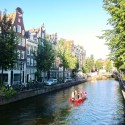
So I dropped 100,000 Delta miles on a KLM business class ticket, non-stop from Amsterdam to New York, traveled through the north of France and Belgium to reach my cold and rainy destination (yes, it is hot over here in the States, but the Europeans would gladly take it. They have had cold and rain followed by more cold and rain, at least in Paris and Amsterdam.)
So my Delta frequent flyer account balance is now down to 438 miles, which means it’ll be a loooong time before I ever sit in the upstairs section of a Boeing-747 and dine on marinated shrimp accompanied by potato salad, cherry tomatoes, vichyssoise, creme of avocado, sweet and sour cucumber, coriander pesto and tapenade (that was just the appetizer) and fillet of chicken complemented by mashed potatoes, pearl onions, chicory, mushrooms and bacon (main course) with a couple glasses of 2011 Castel Firmian Pinoit Grigio from the dynamic Mezzacorona winery in Trentino, Italy.
The diaries will continue from stateside points yet to be determined. The only certainty is that one dateline will be New London, which is nearby.
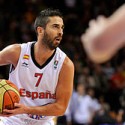
As for that other certainty — Team USA winning the gold, let’s all take a step back and wait and see. Yes, the Americans were my pick, and Spain cannot touch them without Juan Carlos Navarro playing at full strength. I still think Brazil is the biggest threat, but Russia and its crafty American coach, David Blatt, could be the dark horse.
Remember, every team has one bad game during FIBA tournaments. It is a rule of thumb.
Until next time …
(DIARY OF THE UNCREDENTIALED, EDITION I, FROM MANCHESTER, ENGLAND)
(DIARY OF THE UNCREDENTIALED, EDITION II, FROM BARCELONA, SPAIN)
(DIARY OF THE UNCREDENTIALED, EDITION III, FROM PARIS, FRANCE)
Chris Sheridan is publisher and editor-in-chief of SheridanHoops.com. He has covered every version of Team USA since 1996, at the Olympics in Atlanta, Sydney, Athens and Beijing, as well as the World Championships in Indianapolis, Japan and Turkey. Follow him on Twitter.
I am going to give you a Team USA gold-or-not prediction in this column, and I promise you a prediction that goes against the grain. That’s all I’ll say about that … for now.
WASHINGTON, D.C. — President Barack Obama was on Kiss Cam, smooching his wife Michelle, when the outcome was no longer in doubt.
LAS VEGAS — In their continual quest to keep up with American talent, the serious basketball countries in the world have relied on fundamentals, intelligence and, well, Yankee stupidity.

Greece – The Greeks have long been known as a tough challenger in international competitions, especially after their smackdown of Team USA in the 2006 World Championships. The Greek team doesn’t feature any current NBA players, but has several players who have been NBA draft picks and several of the best players Europe has to offer. Led by All-Euroleague first teamer, Vassilis Spanoulis, Greece has a very balanced attack behind European vets Ioannis Bourousis, Nikolas Zisis, Antonis Fotsis and Kostas Kaimakoglou, as well as three NBA rights owned players, Nick Calathes (Florida/Dallas Mavericks) and the Knicks’ pair, Kostas Papanikolaou and Georgis Printezis.
Puerto Rico – Puerto Rico has been a staple in the World Championships and beat the United States by 19 in the first game of the 2004 Athens Olympics. Led by Carlos Arroyo, who just led Besiktas (Deron Williams’ old team) to a championship in the Turkish League and the Euro Challenge, and 2011 NBA Champion, J.J. Barea, the Puerto Rican team will need another guy to step up big for them if they are to have a chance to qualify. While Renaldo Balkman may provide some defense, look for D-League rookie of the year, Edwin Ubiles, to have an outstanding tournament if Puerto Rico is to be in the mix to advance.
Jordan – Featuring no players with any experience in any major leagues in America, Europe or Asia, Jordan will have a tough time competing with two experienced teams. Don’t expect them to come within 30 in the two games they will play.
Lithuania – Despite finishing fifth on their home soil last summer’s Eurobasket, Lithuania has typically been a very strong international team, winning a bronze medal at the last World Championship, and coming in fourth place in the last Olympic tournament. Linas Kleiza appears set to become a leader on this squad, with his athleticism and energy level very difficult to match in this tournament. He is more of a role player and energy guy in the NBA, but on the national team, he will be expected to be one of the pieces that makes Lithuania go.
Nigeria – While Nigeria is by no means a favorite to make it out of this tournament, they will surprise some people over the next few days. Aside from former lottery picks Al-Farouq Aminu and Ike Diogu, Nigeria has several players who are strong contributors in Europe.
Venezuela – Coached by Eric Musselman, Venezuela has a chance to compete with Nigeria for the quarterfinal slot, and they will be relying heavily on New Orleans Hornets guard Greivis Vasquez. Vasquez can lead a team, as he showed last summer and during his time at the University of Maryland, but to get this team an Olympic berth, Vasquez may need to average a triple-double for the tournament.
Russia – Led by Andrei Kirilenko, this team should have little trouble making it back to the Olympics, where they won the bronze medal in 2008.
Rounding out coach David Blatt’s roster will be former NBA first-round picks, Victor Khryapa and Sergey Monya, as well as big men Timofey Mozgov (Nuggets) and former Kansas Jayhawk, Sasha Kaun.
Dominican Republic – Coach Calipari may be able to recruit the best talent to bring championships in college, but it appears he will not have such luck with the Dominican Republic national team. While they will be led by NBA All-Star Al Horford, he is coming off an injury and may not be his dominant self.
South Korea – Korea is in a little bit over its head in this tournament, but this experience will be very important for this emerging basketball market. Former Cal big man Rod Benson spent last season playing (more like dominating) in Korea, and spoke very highly about the competition level and the up-and-coming play of the domestic players. They will probably get whacked in both of their games, but this experience could be a stepping stone for the future for this squad.
FYR Macedonia – The big surprise in last summer’s Eurobasket, Macedonia will need a miracle run from Bo McCalebb to have the slightest chance to play in London. McCalebb is an unbelievable scorer who seems content passing up a chance to be a strong third guard in the NBA in favor of being arguably Europe’s best scorer.
Angola – They won’t wow you with any recognizable names, but they are a squad that plays with energy and effort. No matter who their opponent is, they play hard on both ends for 40 minutes, and their combination of effort and athleticism should be too much for New Zealand to overcome in the group stage.
New Zealand – New Zealand is only here because FIBA lets in the second-place finisher from the weak Oceania region. They have had their moments in international competitions, and were the toast of the town in Indianapolis at the 2002 World Championship, regularly quenching their thirsts at one of America’s great music bars,