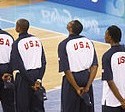
Hubbard: Team USA players opposed to 23-and-under rule for Olympics

7 Comments


LAS VEGAS – Depending on who is asked, the idea is somewhere between harebrained and bizarre, which, come to think about it, isn’t saying a lot for the proposal.

The rule in question is the proposed age limit of 23 for players participating in the Olympics, which has been floated out there as a trial balloon by NBA commissioner David Stern but which has a real chance of being implemented prior to the Rio Games of 2016.

The current members of Team USA, from the top on down, don’t like it.

But Stern is the boss, and the boss has decided that the governing forces of soccer are far more on the ball than their basketball counterparts because they have an age limit of 23 in the Olympics and then open competition in the World Cup, which is a global phenomenon every four years.

So why not follow the lead of soccer and create a World Cup of Basketball?

Nitpickers would point out that making the Olympics worse in order to make the world championship better is a curious strategy. But, then again, the NBA could run a World Cup and benefit financially. and when sports is driven by greed rather than what is best for the sport or its fans, anything is possible.

Count Jerry Colangelo, managing director of the U.S. national team, as one opposed to the change.

Colangelo said he has had a discussion with Stern and told him to step carefully.

“Before any final decision is made, it’s important that all the people understand what the ramifications are – to the current group of players, to the future group of players – what really are the limitations as a result?” Colangelo said. “I think that discussion should be a long, thorough discussion before anyone goes off half cocked. That’s my opinion and I shared that with David.”

If Stern’s plan was currently in effect, the U.S. team would not have Kobe Bryant, LeBron James, Carmelo Anthony, Tyson Chandler, Deron Williams, Chris Paul or Andre Iguodala on the roster.

“There should not be an age limit for the Olympics,” said Chandler, who pointed out that swimmer Dara Torres competed in the 2008 Olympics at age 41. “We wouldn’t have been able to watch her. And we wouldn’t have been able to watch some of the heroic things we have happened over the years. So I’m very against it.”

Five current Team USA players are 23 or younger – Kevin Durant, Russell Westbrook, Kevin Love, Blake Griffin and James Harden. The rule would not impact them now, but it would in four years. Each of the players has the goal to compete in multiple Olympics.

“You only have very few chances to represent your country,” Love said, “so I feel that it comes along every four years and I feel like if you have the chance to do it and you want to make that step and you’re good enough to make the team and represent your country, I think you might as well be able to do it, even when you are older.”

(RELATED CONTENT: David Stern wants to ruin the Olympics)

(RELATED CONTENT: David Stern wants to ruin the Olympics, Part II.)

Although Stern is trying to pump up an event that would replace the World Championship, there is nothing to suggest it would be successful with fans, especially those in the U.S.

The last World Championship held in America was in Indianapolis in 2002, and attendance was awful. If you can find someone who paid extra close attention to the U.S. winning the gold medal in Turkey in 2010, you have made a rare discovery.

And are the TV networks going to pay large bucks to televise an event that few have watched? The NBA undoubtedly would unleash the full force of its marketing and publicity operation, but is creating tradition an instant process? Is it something that impassions fans because they see a series of slick television commercials? Can an autocratic commissioner simply command that fans be interested?

What of the rest of the world? Yes, players from other countries have the privilege of playing in the most popular basketball league in the world, but what if 30-year-old Tony Parker still wants to compete in the Olympics for his country?

And will other countries support such a proposal? FIBA, the governing organization for international basketball – including competition in the Olympics – would have to change rules to adopt a 23-year-old age limit.

“I think it’s a long way from concept to finish line because it’s such a political process to begin with,” Colangelo said. “When you have the NBA, you have FIBA, you have the other world governing bodies and those from the countries – you’ve got to get everyone on the same page.”

Olympic coach Mike Krzyzewski is busy preparing his team for the Olympics and said he hasn’t given the proposal much thought. But from a competitive standpoint, he thought it would be good for the U.S.

”If everybody else was [limited to 23] I think we’d have an advantage,” Krzyzewski said. “Usually the U.S. kind of dominates or wins a lot at the younger age and then it become tougher as you go forward.”

Actually, there are mixed results. In the most recent competitions, the U.S. finished fifth in a tournament involving players 19 and under, but won competitions at 18 and under and 17 and under.

Krzyzewski, however, is missing the point, although it is understandable that he has tunnel vision on preparing the current team.

In international basketball play, the Olympics not only have tradition and history, but also have created an inspiring sense of patriotism among basketball players. It is impressive to listen to players in their 20s, or Kobe Bryant at age 33 talking about the joy of playing for country, wearing U.S. colors and how it genuinely moves them.

That’s not to say for one second that players do not understand business, and that they almost always make decisions that involve accepting the maximum amount of money they can get.

But if you have established a great tradition – and the NBA has in the Olympics – is it something you sell to the highest bidder?

Or is it more accurate to say that you would sell out to the highest bidder?

MORE TEAM USA COVERAGE FROM JAN HUBBARD IN LAS VEGAS:

Tuesday, July 10 - July 10: Kyrie Irving excelling in Team USA camp
Monday, July 9 - Original Dream Team is ancient history for Team USA
Sunday, July 8 - Days of self-destruction are over for U.S.
Saturday, July 7 - Versatile American squad on a mission
Friday, July 6 - The Olympic rich get richer, and the good get better

Jan Hubbard has written about basketball since 1976 and worked in the NBA league office for eight years in between media stints. Follow him on Twitter at @whyhub.

David Stern wants to ruin the Olympics, Part II

5 Comments

OKLAHOMA CITY — I caught up with NBA commissioner David Stern today at an NBA Cares event held at the Oklahoma City rescue mission to press him on the proposal being discussed to limit the Olympic men’s basketball competition to players 23 and under — an item I first wrote about last week with a similar headline.

Here’s the gist of what he said:

_ A big part of the reason why the NBA is pushing this discussion is because they want to increase the visibility and importance of the World Cup of basketball (formerly known as the World Championship). The NBA and FIBA want the World Cup to be as big of an international event as the World Cup of Soccer, and the 23-and-under rule would not apply to the World Cup, which will be held next in Spain in 2014.

My reaction: You can’t kill a good thing to try to fix a not-so-good thing. Men’s basketball is one of the most important events at the Olympics. A vast majority of players, both American and international, are passionate about playing for their national teams. If you make the Olympics less competitive, that will not automatically translate into the World Cup being a compelling event. Americans love the Olympics. Americans ignore the World Championship. If you ruin one, that does not guarantee that you fix the other.

_ Stern said it’s probably a 50-50 proposition that the 23-and-under rule gets implemented, and I am hearing from USA Basketball sources that foreign federations are complaining to FIBA that the United States is trying to gain a competitive advantage because America’s younger players are more seasoned than foreign under-23 players.

My reaction: If you go and tell Manu Ginobili and Luis Scola that they can’t play for Argentina, or if you tell Pau and Marc Gasol that they cannot play for Spain, or Tony Parker that he cannot play for France, they will be apoplectic. Those four players are more loyal (in their hearts, not their wallets) to their national teams than they are to their NBA teams. If this rule gets put into place, there will be a backlash that will be monumental.

_ Stern plans to discuss the 23-and-under rule with FIBA chief Patrick Baumann following the conclusion of the London Olympics. I know for a fact that Baumann wants to do something to make the World Cup a bigger and more prestigious event, because he told me so in Istanbul two summers ago. Baumann complained that many top European players decided to sit out the 2010 Worlds because they were more interested in playing in the 2011 Eurobasket in order to qualify for the 12-team Olympic field.

My reaction: Baumann has to deal with more than 100 Olympic federations, and as good of a relationship as he has with Stern, he does not want to be dictated to by the NBA’s dictator. as I said above, the backlash from other countries (and perhaps from Americans, too) will be so strong that the idea will be tabled for another four years, and the Rio de Janeiro Olympics in 2016 will continue to feature he best of the best, irrespective of age.

_Dallas Mavericks owner Mark Cuban has been the most vocal about keeping star players out of the Olympics, arguing that it is idiotic for NBA teams to cede control of their most valuable assets to foreign federations, then have those players report to training camp running on fumes because they have been practicing and playing for their national teams for the entire summer. At his news conference on the eve of Game 1, Stern said that although he usually disagrees with nearly everything Cuban says and does, on this issue he is in agreement with Cuban.

My reaction: Cuban would feel differently if he attended an Olympics or spent some extended time with Team USA when they are in training camp or competing in a worldwide event. Twenty years ago the decision was made that we’ll send our best, y’all can sent your best, and we’ll see who’s the best. Olympic games are unbelievably intense, incredibly physical and extraordinarily quick (most last about an hour and 45 minutes). Americans have been through too many Olympic letdowns — 1972 Munich, 1988 Seoul, 2004 Athens — to put themselves at a competitive disadvantage with an arbitrary rule that will decrease the level of competition. Yes, a way needs to be found to make the World Cup of Basketball more compelling. Gutting the Olympics is not the answer.

Chris Sheridan is founder, publisher and editor-in-chief of SheridanHoops.com. He has covered Team USA at every Olympics since 1996, and every World Championship since 2002.